About Nebille’s Food Bank

Our Mission, Goals, & Values
Nebille’s Food Bank was created in response to the high levels of food insecurity that afflicts our community within Miami-Dade county.
Our Mission
To alleviate hunger in our community, especially for our most vulnerable – the elderly, children and mothers.
Our Vision
To eradicate hunger in our community and create awareness for food nutrition and wellness and co-creating communities where everyone thrives.
Our Values
Service, Integrity, Teamwork, Respect, Diversity, Innovation

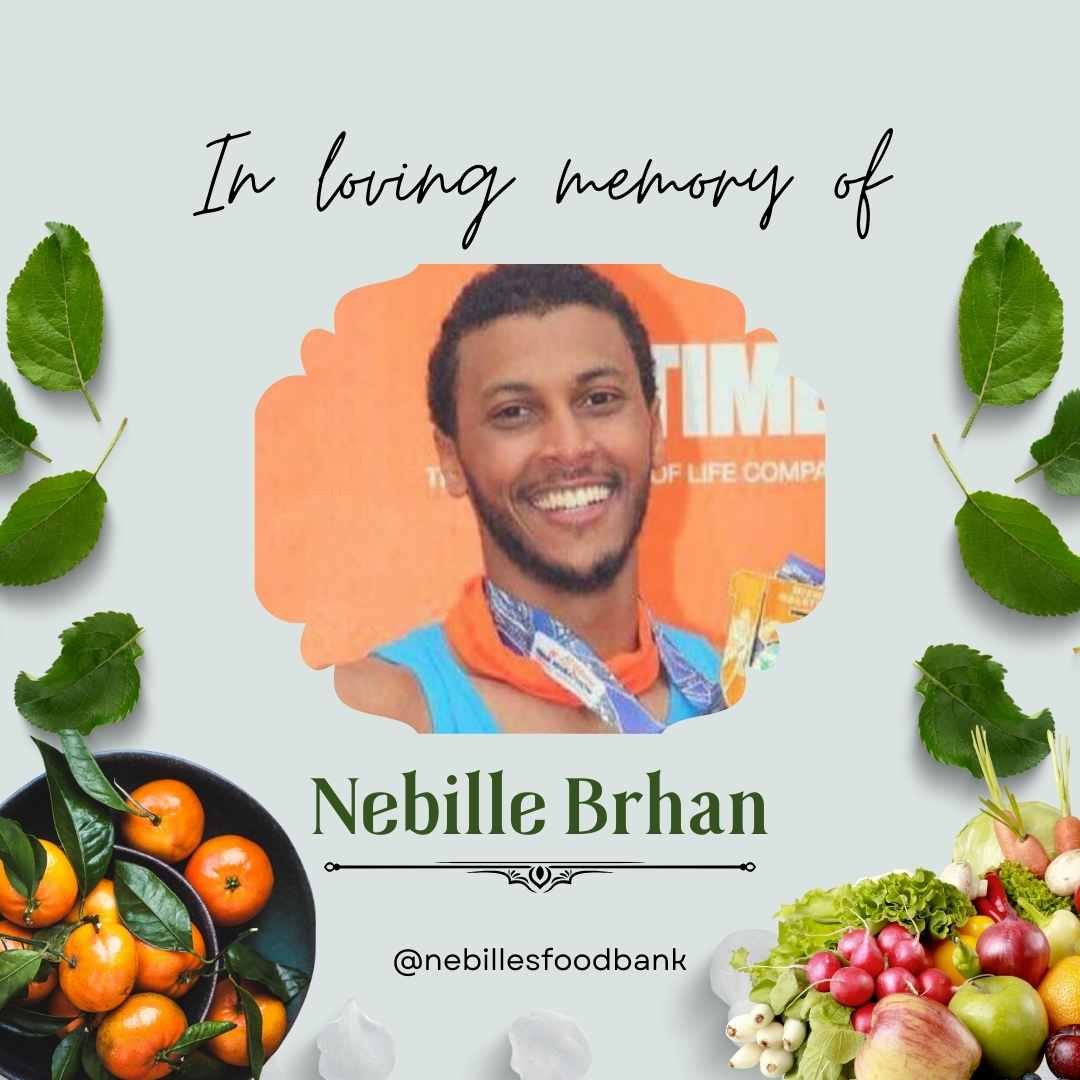
Honoring Nebille Brhan: The Legacy of Service and Community
Nebille’s Food Bank is a 501(c)(3) nonprofit organization established in 2019 in memory of Nebille Brhan, a free-spirited young man loved and missed by his family, friends, and the various communities he touched with his light. The untimely departure of Nebille at a young age of 25 has created a major void in the hearts of those who loved and knew him.
Volunteerism and charity are key values that Nebille exhibited from childhood and carried forward into adulthood. Nebille’s family and friends seek to uphold his legacy of service through the establishment of Nebille’s Food Bank to serve as a testament to Nebille’s generous and nurturing spirit, serving the communities of greater Miami-Dade County that played an important part in his life.
Empowering the Community Through Service
Nebille’s Food Bank translates to philanthropy in the native language of founder Ahmed Mohammed Brhan who visualizes a community resource center driven by volunteers from the growing community of East Africans in the greater Miami-Dade county. Nebille’s Food Bank creates an opportunity to give back to his adopted country and and bring the community together to work towards tackling serious issues facing segments of greater MiamiDade including food security, homelessness, racial tolerance, unemployment & underemployment, especially among minority youth.

Why A Food Bank? Identifying The Problem
fGlobal food production is highly efficient in terms of total output—farmers produce enough food to feed 1.5x of the global population, enough to feed over 10 billion people. The world produces 17% more food per person today than 30 years ago. However, 925 million people do not have enough food to eat—more than the populations of Canada, the USA, and the EU. Women make up a little over half of the world’s population, but they account for over 60% of the world’s hungry. An estimated 30-40 percent of all food in the U.S. is wasted, so it may be surprising that one in eight Americans still find it challenging to put a meal on the table every day.
Addressing Food Waste and Hunger in the U.S.
FOOD WASTE IN THE UNITED STATES
The United States is the global leader in food waste, with Americans discarding nearly 40 million tons of food every year. That’s 80 billion pounds of food and equates to more than $161 billion, approximately 219 pounds of waste per person and 30-40 percent of the US food supply.
Most of this food is sent to landfills; food is the single largest component taking up space inside US landfills. In fact, it makes up 22 percent of municipal solid waste (MSW).
FOOD INSECURITY IN THE UNITED STATES
The United States of America faces an unprecedented period of food insecurity, although it is the world’s greatest food-producing nation. Children and adults face poverty and hunger in every county across America.
In 2018, more than 38 million people lived in poverty in America. For a family of four, that means earning just $25,000 per year. In 2018, more than 37 million people struggled with hunger in the United States, including more than 11 million children.
A household that is food insecure has limited or uncertain access to enough food to support a healthy life. Children are more likely to face food insecurity than any other group in the United States.
The coronavirus pandemic has left millions of families without stable employment. More than 54 million people, including 18 million children, may experience food insecurity in 2020.
FOOD INSECURITY IN SOUTH FLORIDA
Food insecurity ranges from a low of 9.5 percent of the population in Miami-Dade County up to 13.6 percent in Broward County. The average food insecurity rate throughout the country is 12.5 percent and 11.6 percent across South Florida.
11.6% of the South Florida population is food insecure, with 706,430 people not knowing from where they will get their next meal.
83% of the food-insecure population in South Florida qualify based on income for SNAP (Foods Stamps) and other federal nutrition programs, while 17% do NOT qualify for federal nutrition programs and often must rely on emergency food assistance programs and need better wages and employment opportunities to help them meet their basic needs.
18.9% of children in South Florida are food insecure, leaving 236,270 children going to bed hungry.
COVID-19 AND FOOD INSECURITY IN SOUTH FLORIDA
According to a Miami Herald article dated July 2020, South Florida is the worst in the nation for food scarcity as a result of the coronavirus pandemic.
More than one in seven South Florida households now say they sometimes or often do not have enough to eat, according to U.S. Census Bureau data released in July 2020.
Feeding South Florida, one of several food banks distributing food throughout the metro area comprised of Miami-Dade, Broward, and Palm Beach counties, went from serving 706,000 people before the pandemic hit to serving 1.3 million now.

People For People